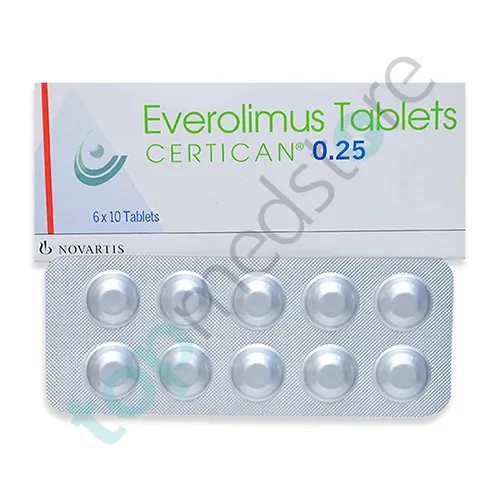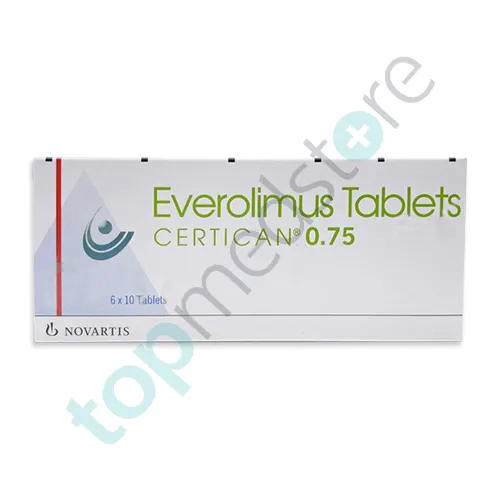
Everolimus 0.75mg
$304.40 – $996.40
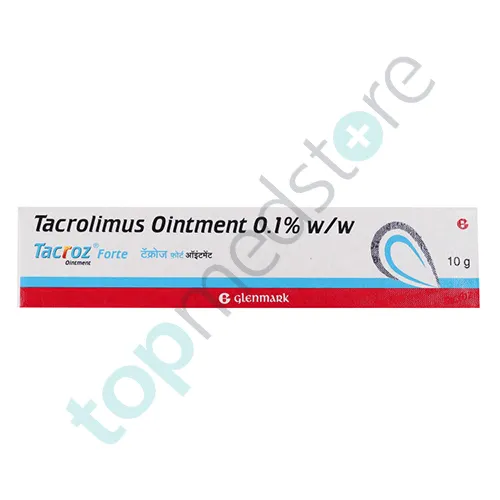
| Product name | Tacrolimus 0.1%-10g |
|---|---|
| Active Ingredient | Tacrolimus |
| Dosage | 0.1% 10g |
| Drug Type | Tubes |
| Indication | Atopic Dermatitis |
| Manufacturer | Glenmark |
Tacrolimus 0.1% 10g Ointment
Out of stock
Total $117.51
Tacrolimus 0.1% Ointment 10g is a prescription topical immunomodulator (skin medicine that controls immune reaction in the skin) used to treat atopic dermatitis (eczema) and other inflammatory skin conditions.
This medicine belongs to a group called calcineurin inhibitors (medicines that reduce immune activity in the skin without using steroids). It is often used when steroid creams are not suitable or when long-term treatment is needed.
Doctors, especially dermatologists (skin specialists), prescribe Tacrolimus 0.1% Ointment for moderate to severe eczema and sensitive skin areas.
The skin acts as a protective barrier. In conditions like eczema, the immune system becomes overactive and damages this barrier.
This leads to inflammation (redness and swelling), itching, dryness, and skin irritation.
The itching can become severe and may lead to scratching. This further damages the skin and increases the risk of infection.
In many patients, symptoms appear in cycles with flare-ups (periods when symptoms suddenly worsen).
Tacrolimus 0.1% Ointment 10g works by calming the immune response in the skin.
It reduces the activity of immune cells that cause inflammation. This helps decrease redness, itching, and irritation.
As inflammation reduces, the skin barrier begins to repair, and the skin becomes smoother and less sensitive.
Doctors prescribe Tacrolimus 0.1% Ointment mainly for atopic dermatitis (eczema), especially in cases where symptoms are persistent or severe.
It is commonly used on sensitive areas such as the face, neck, and skin folds, where long-term steroid use may not be ideal.
It helps reduce itching, redness, and skin thickening caused by chronic inflammation.
In some cases, it is used for other inflammatory skin conditions like vitiligo (loss of skin color in patches) or contact dermatitis, based on medical evaluation.
It is often used as part of a maintenance treatment plan to prevent flare-ups and keep symptoms under control.
Tacrolimus 0.1% Ointment works by blocking a process in the immune system.
It inhibits calcineurin (a protein that activates immune cells responsible for inflammation).
When calcineurin is blocked, immune cells produce fewer inflammatory signals.
This reduces the release of substances that cause itching, redness, and swelling.
Unlike steroids, it does not thin the skin, which makes it suitable for long-term use in delicate areas.
Over time, the skin becomes less reactive and symptoms reduce significantly.
Some patients may experience side effects, especially during the first few days of use.
A common effect is burning or stinging sensation at the application site. This usually improves as the skin adjusts.
Some people may notice skin warmth or mild irritation after applying the ointment.
In some cases, patients may experience itching or redness, especially on sensitive skin.
Rarely, there may be increased sensitivity to sunlight, making the skin more reactive to sun exposure.
Most side effects are temporary and reduce with continued use.
The ointment should be applied as directed and only on affected areas.
Patients should avoid excessive sun exposure and use protection, as the treated skin may become more sensitive.
It should not be applied on infected or open wounds unless advised.
Long-term use should be monitored, especially in patients with sensitive skin conditions.
Hands should be washed after application to avoid accidental contact with eyes or mouth.
Using moisturizers along with this medicine can improve overall skin healing.
This content is for educational purposes only. It is not a substitute for medical advice. Tacrolimus 0.1% Ointment 10g should be used after proper medical evaluation for atopic dermatitis and other inflammatory skin conditions. It is commonly prescribed by a dermatologist.
$304.40 – $996.40
$101.50 – $332.40
$115.50 – $378.00
$205.00 – $670.00