Everolimus 0.75mg
$304.40 – $996.40
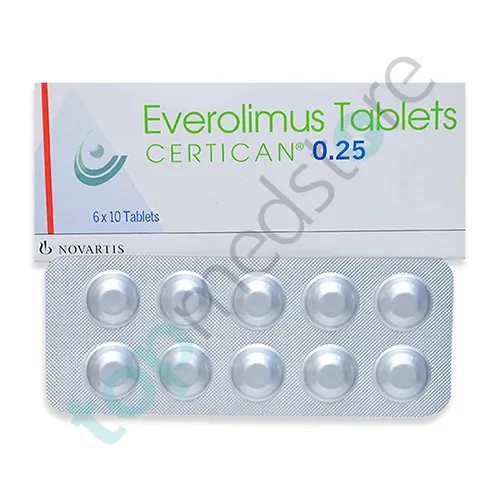
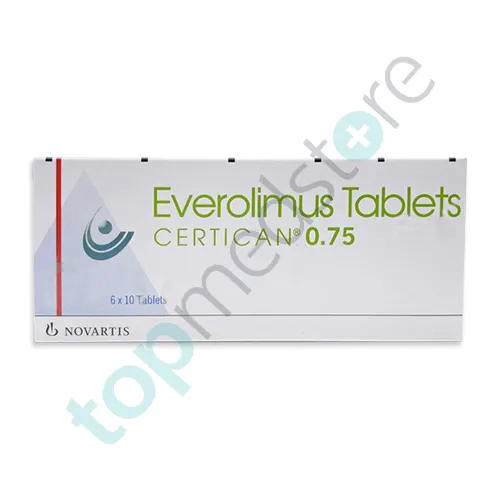
| Product name | Everolimus 0.25mg |
|---|---|
| Active Ingredient | Everolimus |
| Dosage | 0.25mg |
| Drug Type | Tablets |
| Indication | Organ Transplant Rejection Prevention |
| Manufacturer | Novartis |
Total $101.50
Everolimus 0.25mg is a specialized medicine used in cancer treatment and in some cases after organ transplant. It works on the body’s immune system and cell growth process. Because of this, it must be used under the guidance of an oncologist (cancer specialist) or a transplant specialist.
This medicine belongs to a group called mTOR inhibitors (medicines that slow down cell growth and division). In certain diseases, especially cancer, cells grow very fast and out of control. Everolimus helps slow down this abnormal growth.
It is also used in patients who have received an organ transplant. In such cases, the immune system may attack the new organ. Everolimus helps control the immune response (body’s defense system) so the transplanted organ can function properly.
This is a low-strength dose (0.25mg) and is usually part of a carefully planned treatment. Doctors adjust the dose based on the condition, response, and patient safety.
Everolimus 0.25mg is used in different medical conditions where controlling cell growth or immune activity is important.
It is commonly prescribed for:
Certain types of cancer, such as:
Breast cancer
Kidney cancer
Neuroendocrine tumors (tumors that develop in hormone-producing cells)
Organ transplant patients, to prevent organ rejection (when the body attacks the new organ)
Tuberous sclerosis complex (TSC), a condition that causes non-cancerous tumors in different parts of the body
In cancer treatment, this medicine helps:
Slow down tumor growth
Reduce the spread of cancer cells
In transplant care, it helps:
Protect the transplanted organ
Maintain long-term organ function
The effect may take time, so regular use and monitoring are important.
Everolimus 0.25mg works by blocking a specific pathway in the body called the mTOR pathway (a system that controls cell growth and survival).
In many diseases, this pathway becomes overactive. This leads to:
Rapid cell growth
Increased survival of abnormal cells
Everolimus blocks this pathway and slows down these processes.
As a result:
Cancer cells grow more slowly
Abnormal cells stop multiplying
Immune activity is reduced in transplant patients
This helps control disease progression and improves treatment outcomes.
In simple terms, Everolimus slows down the signals that tell cells to grow and multiply, which helps manage serious conditions.
Because Everolimus 0.25mg affects the immune system and cell growth, side effects can occur. Some are mild, while others need attention.
Common side effects:
Mouth ulcers (painful sores inside the mouth)
Weakness or tiredness
Loss of appetite
Diarrhea
Skin rash
Some people may also experience:
Infections (due to reduced immunity)
Swelling in hands or feet
High blood sugar levels
Serious side effects may include:
Lung problems (shortness of breath or cough)
Kidney issues
Increased risk of infections
Delayed wound healing
If you notice fever, breathing difficulty, or unusual symptoms, contact your specialist immediately.
Regular blood tests are often required to monitor your condition during treatment.
Everolimus 0.25mg should be taken exactly as prescribed by an oncologist (cancer specialist) or transplant specialist.
Do not change the dose or stop the medicine on your own. This medicine needs careful monitoring.
Before starting treatment, inform your specialist if you have:
Liver or kidney disease
Diabetes (high blood sugar)
Any ongoing infection
Avoid contact with people who have infections, as your immunity may be low.
Do not take vaccines without medical advice, especially live vaccines.
Avoid grapefruit or grapefruit juice, as it may affect how the medicine works in your body.
If you are pregnant or planning pregnancy, discuss risks with your specialist. This medicine may harm the unborn baby.
Maintain good oral hygiene to reduce the risk of mouth ulcers.
This content is for educational purposes only. It does not replace medical advice, diagnosis, or treatment. Always consult a qualified oncologist (cancer specialist) or an appropriate medical specialist before using Everolimus 0.25mg or any medicine. Do not start or stop any medication without proper guidance.
$304.40 – $996.40
$115.50 – $378.00
$205.00 – $670.00
$334.60 – $1095.20