Febuxostat 40mg
$142.80 – $467.60
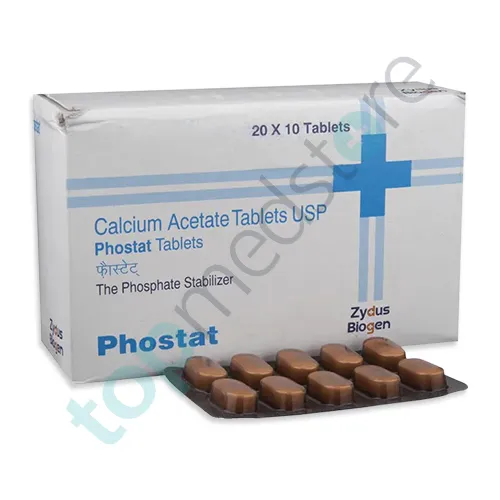
| Product name | Calcium Acetate 667mg |
|---|---|
| Active Ingredient | Calcium Acetate |
| Dosage | 667mg |
| Drug Type | Tablets |
| Indication | Hyperphosphatemia |
| Manufacturer | Zydus Health |
Total $25.00
Calcium Acetate 667mg is a prescription medicine used mainly in people who have long-term kidney disease (a condition where kidneys slowly lose their ability to clean waste and control minerals in the blood). When kidneys do not work properly, one mineral called phosphate (a natural substance found in food that helps build bones and produce energy in the body) starts increasing in the blood.
High phosphate levels are harmful because they can slowly affect bones, heart, and blood vessels. To control this, doctors prescribe Calcium Acetate 667mg, which works as a phosphate binder (a medicine that attaches to phosphate from food in the stomach and stops it from entering the blood).
A nephrologist (a doctor who treats kidney diseases and long-term kidney problems) usually prescribes this medicine after checking blood reports like phosphate, calcium, and kidney function.
This medicine is not a general health supplement. It is a medical treatment used to control mineral imbalance in kidney disease and reduce future complications.
Calcium Acetate 667mg Tablets are mainly used when phosphate levels become high due to kidney problems.
It is used for:
Mineral imbalance in patients with poor kidney function
People on dialysis who need phosphate control support
When kidneys cannot remove phosphate properly, it builds up in the body. This medicine helps reduce that problem.
It helps:
Lower phosphate from food absorption
Maintain balanced mineral levels in blood
Support bone strength in kidney patients
Reduce risk of bone weakness and blood vessel damage
Doctors often combine it with a renal diet (a special diet for kidney patients that controls foods high in phosphate, salt, and potassium).
Normally, kidneys remove extra phosphate from the body. In kidney disease, this process becomes weak.
Calcium Acetate works as a phosphate binder (it attaches to phosphate in the stomach and intestines and forms a compound that cannot be absorbed into the blood).
Simple process:
You eat food that contains phosphate
The medicine binds with phosphate in the stomach
The bound phosphate leaves the body through stool
Less phosphate enters the blood
This helps:
Reduce high phosphate levels
Protect bones from damage
Improve mineral balance in the body
This action is very important in chronic kidney disease mineral and bone disorder (a condition where kidney failure affects bones and mineral balance).
Most people use this medicine safely, but some mild side effects may happen.
Common side effects:
Constipation
Nausea
Stomach discomfort
Bloating
Sometimes:
Weakness
Tiredness
These effects depend on dose, diet, and kidney condition. If symptoms feel strong or unusual, medical advice is needed.
Before starting Calcium Acetate 667mg, doctors check kidney function and blood levels of calcium and phosphate.
Take it exactly as prescribed, usually with meals. This helps it bind phosphate from food properly.
Do not take it on an empty stomach unless your doctor tells you.
Tell your doctor if you have:
High calcium levels
Heart problems
Bone disease
Severe stomach issues
Avoid extra calcium supplements unless prescribed, because too much calcium may cause hypercalcemia (high calcium in blood).
Regular blood tests are important to check:
Phosphate level
Calcium level
Kidney health
Follow a kidney-friendly diet (a diet that avoids high-phosphate foods like processed foods, soft drinks, and some dairy items) for better results.
Do not stop the medicine suddenly without medical advice, as phosphate levels may increase again.
Medical Disclaimer:_x000B_ Calcium Acetate 667mg should be used only under the supervision of a nephrologist. Always consult a qualified healthcare professional for correct diagnosis, safe use, and long-term management of kidney-related mineral imbalance.
$142.80 – $467.60
$67.50 – $220.80
$25.00 – $80.00
$67.50 – $467.60